Strong Earnings and Rate Uncertainty

RECAPPING LAST WEEK


Strong earnings reports from some of the “Magnificent 7” technology companies boosted the
Nasdaq Composite index by 2.3%, while U.S. Treasury yields rose after the Federal Reserve
lowered interest rates but made statements leading to uncertainty about further cuts this year .
The S&P500 gained less than 1% while Russell 2000 slid 1.3%, pressured by a rising U.S. dollar.
Sector performance tilted negative despite technology’s strong showing. Sectors representing real
assets slumped after trade talks between the U.S. and China resulted in a de–escalation of
tensions over issues like rare earth exports, although root causes of the conflict remained
unresolved. Crude oil prices fell 1% after news emerged that OPEC+ is leaning towards another
modest output increase for December. Gold futures fell for a second straight week but stayed
above $4,000 per ounce. Investors were wary of huge artificial intelligence investments by U.S.
firms like Meta Platforms and Microsoft but were reassured by Alphabet’s ability to fund its plans
from current cash flows and Amazon’s strong forecast. Turning to monetary policy, Fed Chair
Powell acknowledged there were “strongly differing views” about how to proceed in December,
given the lack of official government data. His comment that another rate cut is “not a foregone
conclusion” was slightly unnerving to stock and bond investors, although by week’s end the effects
were muted. Odds for a December rate cut fell to around 65%, based on fed funds futures. The
Fed also announced it would restart limited purchases of Treasury securities to maintain ample
liquidity in the banking system. Meanwhile, the U.S. government shutdown extended into a fourth
week with no signs of a resolution, and economic data remained sparse. Research firm ADP
announced it would release a weekly estimate of the change in private sector employment in
addition to its regular monthly report. While the added transparency may help, it still represents a
far–from–complete picture of the U.S. labor market. A Chicago Fed estimate showed the
September unemployment rate likely stayed steady at 4.3%, although ADP noted that corporate
layoffs increased notably last week. Consumer confidence fell in October on dimmer views for the
economy and labor markets. Mortgage rates dropped for a fourth straight week, boosting
refinancing activity and new applications. Overseas, the Bank of Japan kept rates unchanged but
delivered its strongest signal yet that a hike was possible soon. Inflation accelerated to 2.8% in
October, well above the central bank’s 2% target. The European Central Bank also left rates
unchanged and offered no clues about future moves. Economic growth has remained steady in the
Eurozone despite trade turbulence while inflation hovered near the bank’s goal. The Bank of
Canada cut rates by 25 basis points, citing a weakening economy as the impact of U.S. tariffs is
becoming more evident. Finally, China’s manufacturing activity contracted more than expected
last month while services stayed in expansion territory.


THE WEEK AHEAD


A quick programming note—this newsletter will not be published on November 10 but will return
the following week. Typically, the focus for the first week of a new month would be on the U.S.
labor market reports, and while investors will get private data from ADP and the Challenger job
cuts, the absence of official non–farm payrolls for a second month will contribute to ongoing
uncertainty regarding the U.S. economy. The core PCE price index release is another likely victim.
This week’s economic releases unaffected by the shutdown include ISM manufacturing and
services PMIs along with November’s preliminary consumer sentiment index and inflation
expectations. Midweek, the Supreme Court will hear oral arguments regarding the legality of
tariffs imposed by the Trump administration. Though the court may not hand down its ruling for
several months, any headlines from the proceedings may generate some market volatility.
Earnings season is starting to wind down, but a few reports to note include Palantir, Advanced
Micro Devices, Qualcomm, and Sandisk. FOMC members will resume public appearances this
week, and their commentary could be critical in laying the foundation for the December meeting.
On the international side, central banks in the UK and Australia have rate decisions on tap.
Pundits put the odds of a cut from the Bank of England at around 30%, while the Reserve Bank of
Australia is expected to hold rates steady. Finally, China is tentatively scheduled to release trade
balance figures on Thursday evening, with an inflation update to follow on Saturday.


(Schwab)

Annualized Return: The rate at which an investment grows each year over the period to arrive at the final valuation.

Bear Market: A decline of at least 20% from the market’s high point to its low.

Beta: A measure of how an individual asset moves when the overall stock market increases or decreases.

Correlation: A measure of the extent to which two variables are related.

Dividend Yield: The dividend yield or dividend-price ratio of a share is the dividend per share, divided by the price per share. It is also a company’s total annual dividend payments divided by its market capitalization, assuming the number of shares is constant.

Developed Markets: A country that is most developed in terms of its economy and capital markets. The country must be high income, but this also includes openness to foreign ownership, ease of capital movement, and efficiency of market institutions.

Emerging Markets: A country that has some characteristics of a developed market but does not fully meet its standards. This includes markets that may become developed markets in the future or were in the past.

Growth Factor Stocks: Growth stocks are companies expected to grow sales and earnings at a faster rate than the market average.

Large Cap Stocks: Shares of publicly traded corporations with a market capitalization of $10 billion or more.

LTM: An acronym for “Last Twelve Months” or the past one year.

NTM: An acronym for “Next Twelve Months” or the next one year.

Price Return: The rate of return on an investment portfolio, where the return measure takes into account only the capital appreciation of the portfolio, not including income generated in the form of interest or dividends.

Total Return: Return on a portfolio of investments including capital appreciation and income received on the portfolio.

Small Cap Stocks: Small-cap stocks are shares of companies with a market capitalization of less than $2 billion.

Standard Deviation: In statistics, the standard deviation is a measure of the amount of variation or dispersion of a set of values. A low standard deviation indicates the values tend to be close to the historical average of the data set, while a high standard deviation indicates the current value is outside of the historical average range.

Value Factor Stocks: Stocks that are inexpensive relative to the broad market based on measures of fundamental value (e.g., price to earnings or price to book).

Disclosures and legal notice

DISCLAIMER: Futures, stocks and options trading involves substantial risk of loss and is not suitable for every investor. The valuation of futures, stocks and options may fluctuate, and, as a result, clients may lose more than their original investment. The impact of seasonal and geopolitical events is already factored into market prices. The highly leveraged nature of futures trading means that small market movements will have a great impact on your trading account and this can work against you, leading to large losses or can work for you, leading to large gains.

  • If the market moves against you, you may sustain a total loss greater than the amount you deposited into your account. You are responsible for all the risks and financial resources you use and for the chosen trading system. You should not engage in trading unless you fully understand the nature of the transactions you are entering into and the extent of your exposure to loss. If you do not fully understand these risks you must seek independent advice from your financial advisor. All trading strategies are used at your own risk.
  • Any content on T2 Markets Research should not be relied upon as advice or construed as providing recommendations of any kind. It is your responsibility to confirm and decide which trades to make. Trade only with risk capital; that is, trade with money that, if lost, will not adversely impact your lifestyle and your ability to meet your financial obligations. Past results are no indication of future performance. In no event should the content of this correspondence be construed as an express or implied promise or guarantee.
  • T2 Markets Research is not responsible for any losses incurred as a result of using any of our trading strategies. Loss-limiting strategies such as stop loss orders may not be effective because market conditions or technological issues may make it impossible to execute such orders. Likewise, strategies using combinations of options and/or futures positions such as “spread” or “straddle” trades may be just as risky as simple long and short positions. Information provided in this correspondence is intended solely for informational purposes and is obtained from sources believed to be reliable. Information is in no way guaranteed. No guarantee of any kind is implied or possible where projections of future conditions are attempted.

Disclaimer: None of the content published on T2 Markets Research constitutes a recommendation that any particular security, portfolio of securities, transaction or investment strategy is suitable for any specific person. None of the information providers or their affiliates will advise you personally concerning the nature, potential, value or suitability of any particular security, portfolio of securities, transaction, investment strategy or other matter.

Free newsletter

Market Research & Analysis

Get our latest reports and commentary delivered to your inbox.

Keep reading

More from the research library

Short-term yields rising

Global equity markets remained remarkably resilient last week despite another sharp rise in interest rates, elevated energy prices, and the first rate hike from the Federal Reserve in more than three years. U.S. equities initially came under pressure following Wednesdays widely anticipated 25 basis point increase in the Fed Funds target rate to 3.75%-4%, but the selloff was relatively short-lived, with most major indices recovering from their knee-jerk response to the rate announcement.

Read more →

Investors focused on the FOMC’s 2-day meeting

Global equity markets were under pressure last week with rising energy prices, escalating U.S.-Iran hostilities, and another leg higher in Treasury yields. U.S. equities gave back much of the gains from the prior week, with the S&P 500, Nasdaq 100, and Russell 2000 all slipping a little Tuesday through Thursday before regaining some ground on Friday. The selloff was relatively orderly, with the market continuing to focus on whether the increase in energy prices represents a temporary
geopolitical shock or the beginning of a more persistent inflation problem.

Read more →

Final look at inflation data

Global equity markets were quietly choppy this week as investors grappled with a rise in global bond yields, a renewed escalation in U.S.-Iranian hostilities and a shifting outlook for Fed policy.U.S. equities came under pressure early in the week as the global bond selloff and higher energy prices challenged elevated valuations, although stocks recovered as the week progressed, with theS&P 500, Nasdaq 100, and Russell 2000 posting modest gains of under a half a percent.

Read more →

Free newsletter

Market Research & Analysis

Get our latest reports and commentary delivered to your inbox.

Inside a recent report

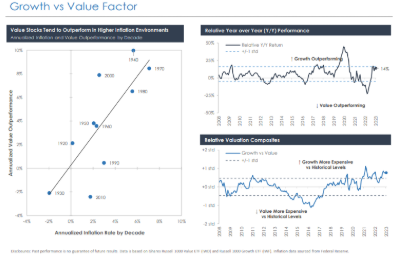
Growth vs Value Factor chart

Growth vs Value Factor — one of the charts from our research.