Final look at inflation data

RECAPPING LAST WEEK


Global equity markets were quietly choppy this week as investors grappled with a rise in global
bond yields, a renewed escalation in U.S.–Iranian hostilities and a shifting outlook for Fed policy.
U.S. equities came under pressure early in the week as the global bond selloff and higher energy
prices challenged elevated valuations, although stocks recovered as the week progressed, with the
S&P 500, Nasdaq 100, and Russell 2000 posting modest gains of under a half a percent. The
markets were ultimately awaiting the Friday release of the August employment report, which
showed payrolls rising a robust 162k versus expectations of 55k along with a revision to July’s
report to reflect growth in payrolls of 21k compared to the initially reported decline of 23k. The
surprisingly strong report pushed market expectations for a 25 bps hike in the Fed Funds target
rate to 58%. While U.S. Treasury yields were pretty much flat on the week, the bond selloff story
took on an international focus with the 10–year Japanese Govt Bond moving above 3% for the first
time since 1996 and similar–maturity German Bunds making 15–year highs. The increase in energy
prices resulting from the resumption in military hostilities with Iran and the potential for inflationary
pressures to be felt more “downstream” is most readily apparent in the price for diesel, which is
near the highs seen during the early onset of the war. Alongside the inelastic steady demand from
the global trucking and shipping industry, the seasonal marginal increase in demand resulting from
Northern Hemisphere farmers preparing for the fall harvest and the roughly 17% of homes in the
Northeast U.S. that utilize the fuel to heat their homes will be exposing those populations to the
sticker shock. The refiners benefiting from “heat (diesel) crack” spreads of $100 a barrel led the
Energy sector to be the week’s strongest performer amongst the S&P 500 sectors, with Consumer
Discretionary correspondingly the worst, at up over 2% and down nearly 2%, respectively. The
other macro sectors that we routinely address (currencies, precious metals, and crypto) all offered
initial knee–jerk reactions to the increased expectation of a rate hike resulting from the strong jobs
report but spent the rest of Friday’s session retracing most or all of it back. The most notable move
in currencies saw the USD weaken against the Japanese Yen back to the lows seen in the
immediate aftermath of the coordinated intervention. A daily chart of the USD/JPY very much
reflects an “escalator up, elevator down” nature of certain markets.


THE WEEK AHEAD

For the 3rd week in a row markets will have to wait until Friday for the main event. The CPI report,
preceded by Thursday’s PPI report, will give market participants one final look at inflation data
ahead of the Fed’s September 16th meeting. Stubbornly high energy prices combined with
elevated yields on the long end of the curve and a 2–year that is trading 50 basis points above the
effective Fed Funds rate are all the sort of market signals that reflect the Fed’s efforts to bring
inflation down to its stated 2% target remain a work in progress. Whether geopolitical
developments related to the Iranian situation escalate or diminish in the coming
days/weeks/months remains the greatest of the known unknowns. However, the ever–present
pricing of tail risk one sees embedded within short–term index option put skew always reminds us
that it’s the unknown unknowns that have the potential to alter everything. Something that we’ll all
be reflecting on as Friday will also commemorate the somber 25th anniversary of the September
11th terrorist attacks.

(Schwab)

Annualized Return: The rate at which an investment grows each year over the period to arrive at the final valuation.

Bear Market: A decline of at least 20% from the market’s high point to its low.

Beta: A measure of how an individual asset moves when the overall stock market increases or decreases.

Correlation: A measure of the extent to which two variables are related.

Dividend Yield: The dividend yield or dividend-price ratio of a share is the dividend per share, divided by the price per share. It is also a company’s total annual dividend payments divided by its market capitalization, assuming the number of shares is constant.

Developed Markets: A country that is most developed in terms of its economy and capital markets. The country must be high income, but this also includes openness to foreign ownership, ease of capital movement, and efficiency of market institutions.

Emerging Markets: A country that has some characteristics of a developed market but does not fully meet its standards. This includes markets that may become developed markets in the future or were in the past.

Growth Factor Stocks: Growth stocks are companies expected to grow sales and earnings at a faster rate than the market average.

Large Cap Stocks: Shares of publicly traded corporations with a market capitalization of $10 billion or more.

LTM: An acronym for “Last Twelve Months” or the past one year.

NTM: An acronym for “Next Twelve Months” or the next one year.

Price Return: The rate of return on an investment portfolio, where the return measure takes into account only the capital appreciation of the portfolio, not including income generated in the form of interest or dividends.

Total Return: Return on a portfolio of investments including capital appreciation and income received on the portfolio.

Small Cap Stocks: Small-cap stocks are shares of companies with a market capitalization of less than $2 billion.

Standard Deviation: In statistics, the standard deviation is a measure of the amount of variation or dispersion of a set of values. A low standard deviation indicates the values tend to be close to the historical average of the data set, while a high standard deviation indicates the current value is outside of the historical average range.

Value Factor Stocks: Stocks that are inexpensive relative to the broad market based on measures of fundamental value (e.g., price to earnings or price to book).

Disclosures and legal notice

DISCLAIMER: Futures, stocks and options trading involves substantial risk of loss and is not suitable for every investor. The valuation of futures, stocks and options may fluctuate, and, as a result, clients may lose more than their original investment. The impact of seasonal and geopolitical events is already factored into market prices. The highly leveraged nature of futures trading means that small market movements will have a great impact on your trading account and this can work against you, leading to large losses or can work for you, leading to large gains.

  • If the market moves against you, you may sustain a total loss greater than the amount you deposited into your account. You are responsible for all the risks and financial resources you use and for the chosen trading system. You should not engage in trading unless you fully understand the nature of the transactions you are entering into and the extent of your exposure to loss. If you do not fully understand these risks you must seek independent advice from your financial advisor. All trading strategies are used at your own risk.
  • Any content on T2 Markets Research should not be relied upon as advice or construed as providing recommendations of any kind. It is your responsibility to confirm and decide which trades to make. Trade only with risk capital; that is, trade with money that, if lost, will not adversely impact your lifestyle and your ability to meet your financial obligations. Past results are no indication of future performance. In no event should the content of this correspondence be construed as an express or implied promise or guarantee.
  • T2 Markets Research is not responsible for any losses incurred as a result of using any of our trading strategies. Loss-limiting strategies such as stop loss orders may not be effective because market conditions or technological issues may make it impossible to execute such orders. Likewise, strategies using combinations of options and/or futures positions such as “spread” or “straddle” trades may be just as risky as simple long and short positions. Information provided in this correspondence is intended solely for informational purposes and is obtained from sources believed to be reliable. Information is in no way guaranteed. No guarantee of any kind is implied or possible where projections of future conditions are attempted.

Disclaimer: None of the content published on T2 Markets Research constitutes a recommendation that any particular security, portfolio of securities, transaction or investment strategy is suitable for any specific person. None of the information providers or their affiliates will advise you personally concerning the nature, potential, value or suitability of any particular security, portfolio of securities, transaction, investment strategy or other matter.

Free newsletter

Market Research & Analysis

Get our latest reports and commentary delivered to your inbox.

Keep reading

More from the research library

Short-term yields rising

Global equity markets remained remarkably resilient last week despite another sharp rise in interest rates, elevated energy prices, and the first rate hike from the Federal Reserve in more than three years. U.S. equities initially came under pressure following Wednesdays widely anticipated 25 basis point increase in the Fed Funds target rate to 3.75%-4%, but the selloff was relatively short-lived, with most major indices recovering from their knee-jerk response to the rate announcement.

Read more →

Investors focused on the FOMC’s 2-day meeting

Global equity markets were under pressure last week with rising energy prices, escalating U.S.-Iran hostilities, and another leg higher in Treasury yields. U.S. equities gave back much of the gains from the prior week, with the S&P 500, Nasdaq 100, and Russell 2000 all slipping a little Tuesday through Thursday before regaining some ground on Friday. The selloff was relatively orderly, with the market continuing to focus on whether the increase in energy prices represents a temporary
geopolitical shock or the beginning of a more persistent inflation problem.

Read more →

Payrolls are expected to recover

Global markets were relatively quiet this past week with most major macro asset classes modestly reversing some of the prior week’s sharper moves in a quiet consolidation. The S&P 500 and Nasdaq 100 each rose about a half of a percent, while the small-cap Russell 2000 fell 1.5%.

Read more →

Free newsletter

Market Research & Analysis

Get our latest reports and commentary delivered to your inbox.

Inside a recent report

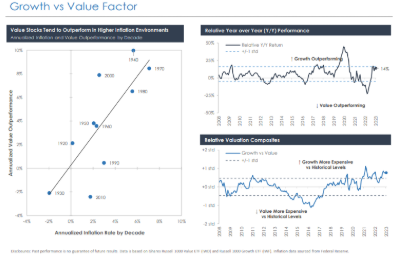
Growth vs Value Factor chart

Growth vs Value Factor — one of the charts from our research.