Annualized Return: The rate at which an investment grows each year over the period to arrive at the final valuation.
Bear Market: A decline of at least 20% from the market’s high point to its low.
Beta: A measure of how an individual asset moves when the overall stock market increases or decreases.
Correlation: A measure of the extent to which two variables are related.
Dividend Yield: The dividend yield or dividend-price ratio of a share is the dividend per share, divided by the price per share. It is also a company’s total annual dividend payments divided by its market capitalization, assuming the number of shares is constant.
Developed Markets: A country that is most developed in terms of its economy and capital markets. The country must be high income, but this also includes openness to foreign ownership, ease of capital movement, and efficiency of market institutions.
Emerging Markets: A country that has some characteristics of a developed market but does not fully meet its standards. This includes markets that may become developed markets in the future or were in the past.
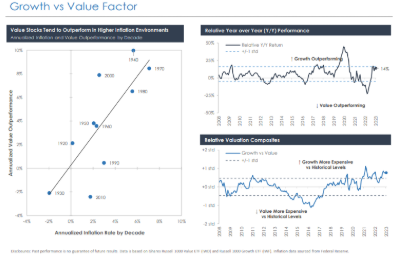
Growth Factor Stocks: Growth stocks are companies expected to grow sales and earnings at a faster rate than the market average.
Large Cap Stocks: Shares of publicly traded corporations with a market capitalization of $10 billion or more.
LTM: An acronym for “Last Twelve Months” or the past one year.
NTM: An acronym for “Next Twelve Months” or the next one year.
Price Return: The rate of return on an investment portfolio, where the return measure takes into account only the capital appreciation of the portfolio, not including income generated in the form of interest or dividends.
Total Return: Return on a portfolio of investments including capital appreciation and income received on the portfolio.
Small Cap Stocks: Small-cap stocks are shares of companies with a market capitalization of less than $2 billion.
Standard Deviation: In statistics, the standard deviation is a measure of the amount of variation or dispersion of a set of values. A low standard deviation indicates the values tend to be close to the historical average of the data set, while a high standard deviation indicates the current value is outside of the historical average range.
Value Factor Stocks: Stocks that are inexpensive relative to the broad market based on measures of fundamental value (e.g., price to earnings or price to book).