NVDA CEO out….or back in?

RECAPPING LAST WEEK


U.S equities staged a sharp rebound, recovering much of the prior week’s selloff despite continued
weakness in one of the market’s largest components, Nvidia. The S&P 500 and Nasdaq advanced
strongly as investors looked beyond the turmoil in the AI trade and responded to improving
corporate earnings. The rebound was particularly notable given Nvidia’s continued decline, which
accelerated Thursday after the abrupt resignation of CEO Jensen Huang amid growing controversy
surrounding his reported affairs with a business executive with alleged ties to Chinese intelligence
and separately one of his direct reports. However, gains in competing chipmakers like AMD and
Broadcom, along with relative strength in the broader indices, suggests that investors are
increasingly differentiating between company–specific risks and the longer–term demand for AI
infrastructure. Earnings announcements also helped support the recovery. Concerns about neo–
cloud providers’ ongoing ability to finance their expansion via debt were eased somewhat by
CoreWeave’s results, as well as statements regarding their ability to secure asset backed
financing. Cisco and Applied Materials reported better–than–expected results, reassuring investors
that demand for networking equipment and semiconductors remains strong. In light of the equity
rebound Treasuries retreated, no longer supported by the “flight to quality” response and also
pressured by hotter–than–expected CPI data. The report, combined with increasingly hawkish
comments from Federal Reserve officials, cemented market expectations for a rate hike in
December. Fed Fund futures are now pricing in a 90% chance of a 25–bps hike and a 10% chance
of a 50–bps hike. Gold similarly retreated as the prospect of higher real interest rates and a US
Dollar that rallied into new yearly highs outweighed its safe–haven appeal. Crypto, which as we
pointed out last week, didn’t benefit from any “safe haven” bid during the equity market selloff,
continued its retreat, also adversely impacted by the strong dollar and market expectations for
interest rates to remain “higher for longer.” Energy markets remained closely tied to developments
in the Iranian conflict. Oil initially fell sharply on Monday on hopes that negotiations could prevent
a renewed escalation. But then, as the administration signaled reduced interest in reaching a
diplomatic agreement, prices remained firm throughout the rest of the week. In a Friday morning
interview on CNBC, Treasury Secretary Bessent stated his belief that the Iranian regime would
eventually crumple under the weight of the economic pressure that he’s spearheading. In a
measure of the broad–based nature of the equity rebound, all 11 of the S&P 500 Sectors were
positive for the week, led by Energy (up over 5%), with Materials as the laggard (up .5%).


THE WEEK AHEAD


Over
 the coming week, expect the market to attempt to reconcile the competing impacts of asharp rebound in equities and a less favorable interest–rate backdrop. After the latest inflationdata pushed Treasury yields higher and strengthened expectations for further Fed tightening,investors will be looking for signs that the equity recovery can hold up even under these less–supportive financial conditions. The most consequential earnings announcement will be Nvidia onTuesday. Despite the sudden departure of their visionary CEO, the company remains the nexus ofthe whole AI trade. Results from Walmart, Home Depot, and Target will also provide an importantread on consumer spending and resilience heading into the holiday season, and Tuesday’s releaseof October retail sales will offer a macro headline number on the same subject. Wednesday willsee the release of the minutes from the October FOMC meeting in which the committee held ratessteady, but it’s not expected that anything contained therein will alter the market having fullypriced in a December hike.

(Schwab)

Annualized Return: The rate at which an investment grows each year over the period to arrive at the final valuation.

Bear Market: A decline of at least 20% from the market’s high point to its low.

Beta: A measure of how an individual asset moves when the overall stock market increases or decreases.

Correlation: A measure of the extent to which two variables are related.

Dividend Yield: The dividend yield or dividend-price ratio of a share is the dividend per share, divided by the price per share. It is also a company’s total annual dividend payments divided by its market capitalization, assuming the number of shares is constant.

Developed Markets: A country that is most developed in terms of its economy and capital markets. The country must be high income, but this also includes openness to foreign ownership, ease of capital movement, and efficiency of market institutions.

Emerging Markets: A country that has some characteristics of a developed market but does not fully meet its standards. This includes markets that may become developed markets in the future or were in the past.

Growth Factor Stocks: Growth stocks are companies expected to grow sales and earnings at a faster rate than the market average.

Large Cap Stocks: Shares of publicly traded corporations with a market capitalization of $10 billion or more.

LTM: An acronym for “Last Twelve Months” or the past one year.

NTM: An acronym for “Next Twelve Months” or the next one year.

Price Return: The rate of return on an investment portfolio, where the return measure takes into account only the capital appreciation of the portfolio, not including income generated in the form of interest or dividends.

Total Return: Return on a portfolio of investments including capital appreciation and income received on the portfolio.

Small Cap Stocks: Small-cap stocks are shares of companies with a market capitalization of less than $2 billion.

Standard Deviation: In statistics, the standard deviation is a measure of the amount of variation or dispersion of a set of values. A low standard deviation indicates the values tend to be close to the historical average of the data set, while a high standard deviation indicates the current value is outside of the historical average range.

Value Factor Stocks: Stocks that are inexpensive relative to the broad market based on measures of fundamental value (e.g., price to earnings or price to book).

Disclosures and legal notice

DISCLAIMER: Futures, stocks and options trading involves substantial risk of loss and is not suitable for every investor. The valuation of futures, stocks and options may fluctuate, and, as a result, clients may lose more than their original investment. The impact of seasonal and geopolitical events is already factored into market prices. The highly leveraged nature of futures trading means that small market movements will have a great impact on your trading account and this can work against you, leading to large losses or can work for you, leading to large gains.

  • If the market moves against you, you may sustain a total loss greater than the amount you deposited into your account. You are responsible for all the risks and financial resources you use and for the chosen trading system. You should not engage in trading unless you fully understand the nature of the transactions you are entering into and the extent of your exposure to loss. If you do not fully understand these risks you must seek independent advice from your financial advisor. All trading strategies are used at your own risk.
  • Any content on T2 Markets Research should not be relied upon as advice or construed as providing recommendations of any kind. It is your responsibility to confirm and decide which trades to make. Trade only with risk capital; that is, trade with money that, if lost, will not adversely impact your lifestyle and your ability to meet your financial obligations. Past results are no indication of future performance. In no event should the content of this correspondence be construed as an express or implied promise or guarantee.
  • T2 Markets Research is not responsible for any losses incurred as a result of using any of our trading strategies. Loss-limiting strategies such as stop loss orders may not be effective because market conditions or technological issues may make it impossible to execute such orders. Likewise, strategies using combinations of options and/or futures positions such as “spread” or “straddle” trades may be just as risky as simple long and short positions. Information provided in this correspondence is intended solely for informational purposes and is obtained from sources believed to be reliable. Information is in no way guaranteed. No guarantee of any kind is implied or possible where projections of future conditions are attempted.

Disclaimer: None of the content published on T2 Markets Research constitutes a recommendation that any particular security, portfolio of securities, transaction or investment strategy is suitable for any specific person. None of the information providers or their affiliates will advise you personally concerning the nature, potential, value or suitability of any particular security, portfolio of securities, transaction, investment strategy or other matter.

Free newsletter

Market Research & Analysis

Get our latest reports and commentary delivered to your inbox.

Keep reading

More from the research library

Rebounding after a turbulent week

U.S. equities endured a turbulent week: after markets initially welcomed decisive victories that would leave no room for protracted court battles contesting the midterm results, investors on Thursday reassessed the implications for the massive AI infrastructure buildout in the wake of a number of states’ and municipalities’ anticipated opposition to data center construction.

Read more →

U.S. congressional elections to command attention this week

Technology and energy markets diverged sharply this week, while the Federal Reserve’s steady hand proved less decisive than initially suggested. Equities opened on a constructive note Monday following news of Anthropic’s S-1 filing, but sentiment reversed by midweek as hyperscaler earnings from Alphabet, Amazon, and Intel reignited concerns over the scale of AI-related capital expenditure.

Read more →

Packed economic and earnings calendar

U.S. equities delivered a mixed performance this week as investors navigated a sharp decline in Treasury yields, escalating geopolitical risk, and growing concerns about the sustainability of the
AI investment boom. Beneath the headline indices, the divergence between technology stocks and the broader market became increasingly pronounced as investors reassessed the valuations of companies at the center of the AI trade.

Read more →

Free newsletter

Market Research & Analysis

Get our latest reports and commentary delivered to your inbox.

Inside a recent report

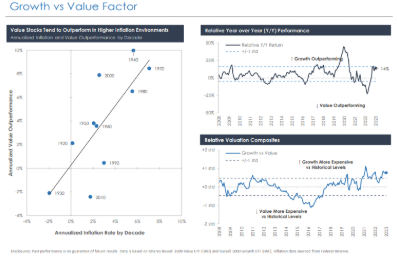
Growth vs Value Factor chart

Growth vs Value Factor — one of the charts from our research.