NFP Jobs data and a holiday shortened week ahead

RECAPPING LAST WEEK


Last week’s overarching story in equity markets was the artificial intelligence trade—after an
extraordinary run, investors decided it had become overextended. Heavy declines in Samsung
Electronics and SK Hynix fueled an over 10% decline in South Korea’s KOSPI index on Tuesday, a
market that is still up 125% YTD. At midweek, all eyes turned to Micron Technologies quarterly
earnings—where the company delivered another exceptionally strong report that reinforced
expectations of ongoing robust demand for memory chips. However this story, which reinforced the
bullish case for AI–related capital spending, was undercut by Apple’s subsequent announcement
that they would no longer absorb surging chip costs, and therefore raised prices on their laptops,
tablets, and other devices. This led to a selloff in several of the companies’ “Magnificent Seven”
peers. Defensive names were the biggest beneficiaries of the rotation: Healthcare, Utilities, and
Consumer Staples sectors gained, while Consumer Discretionary and Communication Services
were pressured along with the Technology sector. Despite the churn in equities, the broader
macroeconomic backdrop remained relatively constructive—crude oil’s decline to pre–war prices
below $70 per barrel helped temper inflation concerns, leading to modest declines across the
Treasury yield curve. Declines in energy prices and inflation expectations impacted precious
metals, as did strength in the dollar, which is just off its 1–year highs. In an interview on CNBC,
Secretary Bessent used Venezuela’s and Iran’s new ability to sell oil for dollars to outline a vision
that would not only maintain but expand the dollar’s central role in international trade and as the
world’s reserve currency. Bitcoin meandered near its one–year lows, as investors found no
support for crypto assets in any of this news.


THE WEEK AHEAD


The U.S. Employment report will certainly be the highlight of this shortened holiday week that
ends the first half of 2026. From March through May the economy generated an average of 155k
jobs per month. Economists, who vastly underestimated each of those figures now expect that the
U.S. will have created 114k jobs in June. Other labor market data will serve as appetizers to
Thursday’s main course, including the JOLTS jobs openings report on Tuesday and the ADP private
payrolls report on Wednesday. Stronger–than–expected figures from these reports could increase
the odds of a 25 bps hike in the Federal funds rate as soon as late July’s FOMC meeting—those
odds currently sit at just 30%. While crude oil’s sharp decline has certainly helped temper long–
term inflation expectations, those declines have yet to filter down to consumers at the pump.
“Crack spreads”–a proxy for refining margins, remain near their wartime highs. Economists refer to
this well–understood phenomenon as “Sticky downward prices”—it occurs when the decline in
price of a finished good (gasoline) lags a decline in the price of its input (crude oil). The Russell
indices will rebalance on Monday, driving additional intramarket activity following on from the
divergence in memory chip suppliers and buyers last week. The most notable event will, of course,
be the addition of SpaceX to the large cap Russell 1000 index along with pre–positioning flows
ahead of its anticipated addition to the Nasdaq 100 Index on July 6th.

(Schwab)

Annualized Return: The rate at which an investment grows each year over the period to arrive at the final valuation.

Bear Market: A decline of at least 20% from the market’s high point to its low.

Beta: A measure of how an individual asset moves when the overall stock market increases or decreases.

Correlation: A measure of the extent to which two variables are related.

Dividend Yield: The dividend yield or dividend-price ratio of a share is the dividend per share, divided by the price per share. It is also a company’s total annual dividend payments divided by its market capitalization, assuming the number of shares is constant.

Developed Markets: A country that is most developed in terms of its economy and capital markets. The country must be high income, but this also includes openness to foreign ownership, ease of capital movement, and efficiency of market institutions.

Emerging Markets: A country that has some characteristics of a developed market but does not fully meet its standards. This includes markets that may become developed markets in the future or were in the past.

Growth Factor Stocks: Growth stocks are companies expected to grow sales and earnings at a faster rate than the market average.

Large Cap Stocks: Shares of publicly traded corporations with a market capitalization of $10 billion or more.

LTM: An acronym for “Last Twelve Months” or the past one year.

NTM: An acronym for “Next Twelve Months” or the next one year.

Price Return: The rate of return on an investment portfolio, where the return measure takes into account only the capital appreciation of the portfolio, not including income generated in the form of interest or dividends.

Total Return: Return on a portfolio of investments including capital appreciation and income received on the portfolio.

Small Cap Stocks: Small-cap stocks are shares of companies with a market capitalization of less than $2 billion.

Standard Deviation: In statistics, the standard deviation is a measure of the amount of variation or dispersion of a set of values. A low standard deviation indicates the values tend to be close to the historical average of the data set, while a high standard deviation indicates the current value is outside of the historical average range.

Value Factor Stocks: Stocks that are inexpensive relative to the broad market based on measures of fundamental value (e.g., price to earnings or price to book).

Disclosures and legal notice

DISCLAIMER: Futures, stocks and options trading involves substantial risk of loss and is not suitable for every investor. The valuation of futures, stocks and options may fluctuate, and, as a result, clients may lose more than their original investment. The impact of seasonal and geopolitical events is already factored into market prices. The highly leveraged nature of futures trading means that small market movements will have a great impact on your trading account and this can work against you, leading to large losses or can work for you, leading to large gains.

  • If the market moves against you, you may sustain a total loss greater than the amount you deposited into your account. You are responsible for all the risks and financial resources you use and for the chosen trading system. You should not engage in trading unless you fully understand the nature of the transactions you are entering into and the extent of your exposure to loss. If you do not fully understand these risks you must seek independent advice from your financial advisor. All trading strategies are used at your own risk.
  • Any content on T2 Markets Research should not be relied upon as advice or construed as providing recommendations of any kind. It is your responsibility to confirm and decide which trades to make. Trade only with risk capital; that is, trade with money that, if lost, will not adversely impact your lifestyle and your ability to meet your financial obligations. Past results are no indication of future performance. In no event should the content of this correspondence be construed as an express or implied promise or guarantee.
  • T2 Markets Research is not responsible for any losses incurred as a result of using any of our trading strategies. Loss-limiting strategies such as stop loss orders may not be effective because market conditions or technological issues may make it impossible to execute such orders. Likewise, strategies using combinations of options and/or futures positions such as “spread” or “straddle” trades may be just as risky as simple long and short positions. Information provided in this correspondence is intended solely for informational purposes and is obtained from sources believed to be reliable. Information is in no way guaranteed. No guarantee of any kind is implied or possible where projections of future conditions are attempted.

Disclaimer: None of the content published on T2 Markets Research constitutes a recommendation that any particular security, portfolio of securities, transaction or investment strategy is suitable for any specific person. None of the information providers or their affiliates will advise you personally concerning the nature, potential, value or suitability of any particular security, portfolio of securities, transaction, investment strategy or other matter.

Free newsletter

Market Research & Analysis

Get our latest reports and commentary delivered to your inbox.

Keep reading

More from the research library

Short-term yields rising

Global equity markets remained remarkably resilient last week despite another sharp rise in interest rates, elevated energy prices, and the first rate hike from the Federal Reserve in more than three years. U.S. equities initially came under pressure following Wednesdays widely anticipated 25 basis point increase in the Fed Funds target rate to 3.75%-4%, but the selloff was relatively short-lived, with most major indices recovering from their knee-jerk response to the rate announcement.

Read more →

Investors focused on the FOMC’s 2-day meeting

Global equity markets were under pressure last week with rising energy prices, escalating U.S.-Iran hostilities, and another leg higher in Treasury yields. U.S. equities gave back much of the gains from the prior week, with the S&P 500, Nasdaq 100, and Russell 2000 all slipping a little Tuesday through Thursday before regaining some ground on Friday. The selloff was relatively orderly, with the market continuing to focus on whether the increase in energy prices represents a temporary
geopolitical shock or the beginning of a more persistent inflation problem.

Read more →

Final look at inflation data

Global equity markets were quietly choppy this week as investors grappled with a rise in global bond yields, a renewed escalation in U.S.-Iranian hostilities and a shifting outlook for Fed policy.U.S. equities came under pressure early in the week as the global bond selloff and higher energy prices challenged elevated valuations, although stocks recovered as the week progressed, with theS&P 500, Nasdaq 100, and Russell 2000 posting modest gains of under a half a percent.

Read more →

Free newsletter

Market Research & Analysis

Get our latest reports and commentary delivered to your inbox.

Inside a recent report

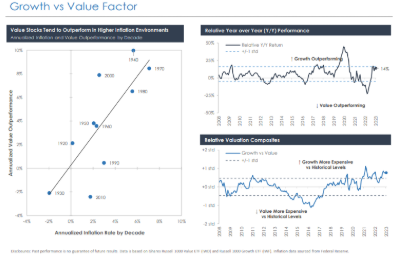
Growth vs Value Factor chart

Growth vs Value Factor — one of the charts from our research.